
Caribou County Court Records After Arrest
After a Caribou County jail arrest, the record path splits. The jail booking record concerns intake, custody, release, and local bond status. The court record begins when formal charges are filed and entered into the court system. Caribou County's prosecutor is S. Doug Wood, listed by the Idaho Prosecuting Attorneys Association and county court page at 159 South Main in Soda Springs. The prosecutor decides what charges are filed after an arrest, and those filed charges can differ from booking allegations.
For custody and booking details, use Caribou County jail inmate records. For booking photos, use the records-focused Caribou County jail mugshots page. For court records after a jail arrest, the key source is Idaho iCourt/Odyssey, plus court and prosecutor contacts when a case is older, sealed, unclear, or not yet visible.
Find Caribou County Court Records After Arrest
The official court search path is the Idaho iCourt/Odyssey portal. Caribou County is part of Idaho's statewide iCourt system. Public users can use Smart Search for case records and Search Hearings for hearing dates. The iCourt public information source says public access does not require registration for basic searches, while extended access requires approval. A new arrest may not appear immediately if charges have not yet been filed.
- Start with the jail booking desk if the arrest just happened and no case appears yet.
- Search iCourt Smart Search by defendant name in Last, First format or by case number.
- Open the public case result and review charge details, bond information, hearings, and disposition events.
- Use Search Hearings and select Caribou County when the next court date is the main question.
- Contact the court clerk for older, unclear, sealed, or exempt records that do not appear publicly.
The screenshot below shows the Idaho iCourt/Odyssey portal, which provides Smart Search, hearing search, and payment tools for public court records.
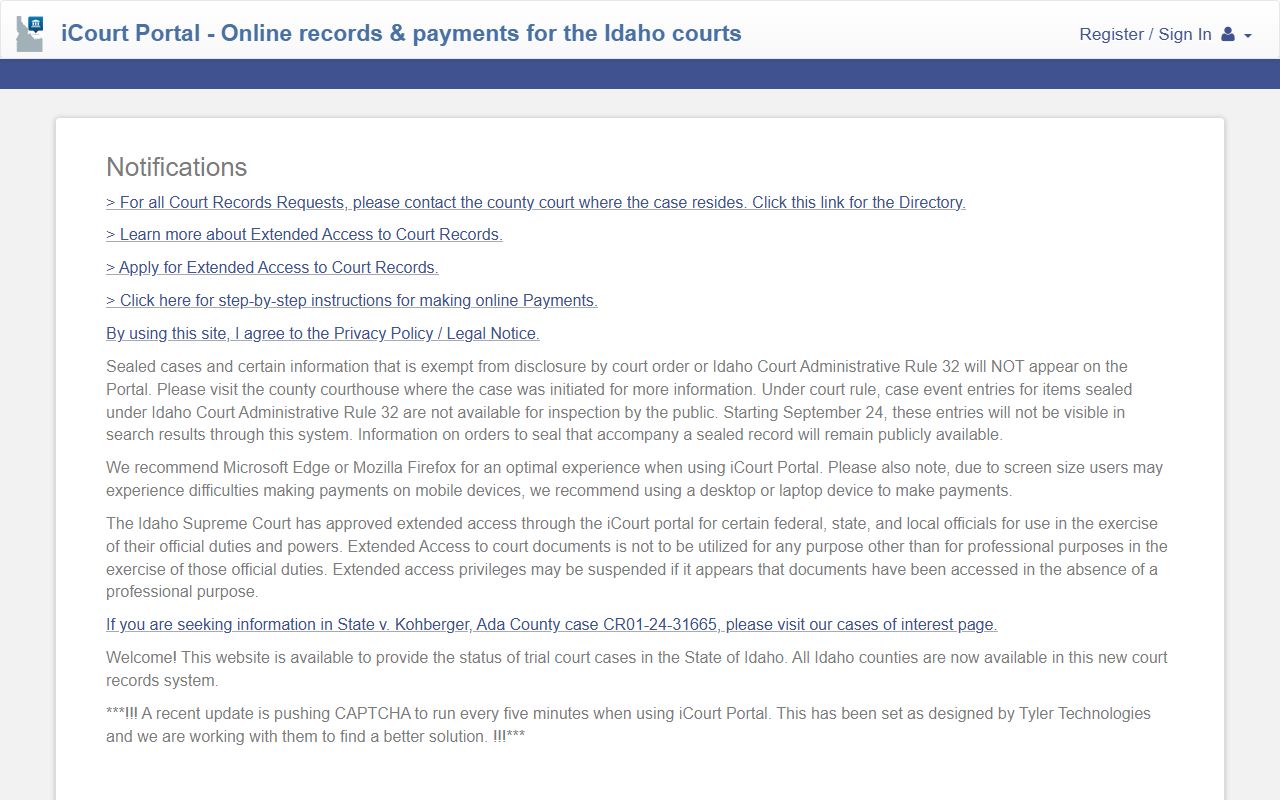
The portal is the court-record source; it does not replace direct jail custody confirmation for fresh bookings.
Caribou County Court Search Fields
iCourt provides several public search tools. Smart Search is used for court records by party name or case number. Search Hearings is used for calendars by date, county, and hearing type. Make Payments is available for criminal and traffic payments when the user has the right case or payment information. iCourt requires JavaScript and cookies and uses CAPTCHA, so a search may fail for technical reasons that have nothing to do with the case itself.
| Field / Tool | Type | Required | Notes |
|---|---|---|---|
| Smart Search | Portal search | No registration for public use | Search court records by case number or party name. |
| Case/Record Number | Text | Optional | Full number preferred; tutorial example is CR-2016-1234. |
| Party Name | Text | Optional | Use Last, First; wildcard requires at least four letters plus *. |
| Search Hearings | Portal search | Optional | Search hearing schedules by county, date, and type. |
| County | Dropdown | Required for hearing search | Select Caribou County for local hearings. |
Charges Filed After Jail Arrest
The arrest begins the jail record, but the charging document begins the formal court case. In ordinary terms, a complaint is an initial charging document, an information is a prosecutor-filed formal charge often used in felony cases after probable-cause steps, and an indictment is a grand-jury charging document. Not every Caribou County case will use every document type, and iCourt should be checked for the case type, charge details, and docket events that actually appear.
| Document | Plain-English Role | What to Check |
|---|---|---|
| Complaint | Initial criminal charge document often used to start a case. | Case type, charge language, filing date, and defendant name. |
| Information | Prosecutor-filed formal charge, often in felony procedure. | Amended counts, charge severity, and probable-cause events. |
| Indictment | Grand-jury charging document. | Filed counts, docket entries, and court orders. |
Caribou County Charge Status
Charges can change after arrest. Booking charges may be amended, reduced, added, dismissed, or replaced once the prosecutor reviews the case. The court record controls the filed criminal case, while the jail record controls custody. A person can bond out while the court case remains active, or a case can remain searchable long after the person leaves jail.
| Status | What It Means |
|---|---|
| Pending | The charge has been filed but not finally resolved. |
| Amended | The charge or count changed after filing. |
| Reduced | The charge was lowered to a lesser offense or lower severity. |
| Dismissed | The court or prosecutor ended that charge without a conviction. |
| Acquitted | The defendant was found not guilty. |
| Conviction | A final guilty finding or guilty plea was accepted by the court. |
Bond After Caribou County Arrest
The Caribou County inmate handbook says all misdemeanors and most warrants have a set bond, but a felony arrest without an arrest warrant requires a judge to set bond. The handbook defines bond as money posted as a promise to appear. It also lists a local bond fee: $10 for the first charge and $5 for each charge after that, capped at $20, with the fee paid in exact separate cash. If bond is $100, the handbook example says $110 is needed for release.
Idaho Criminal Rule 46 governs release and bail decisions in non-capital cases before plea or verdict. Courts may consider ties to the community, criminal record, prior court appearances, charge seriousness, danger to others, and other factors. MyCourts and CitePay links may help with court or citation payments, but cash-bond instructions should be verified with the booking desk before anyone tries to post bond.
| Bond Type | How It Works Locally |
|---|---|
| Cash bond | Handbook says cash, money order, cashier's check, or traveler's check; no personal checks or credit cards for cash bond. |
| Surety bond | A private bail bondsman may post bond for a fee and may require a co-signer. |
| Property bond | Caribou handbook says property bonds are posted only through the court. |
| Recognizance release | Idaho Criminal Rule 46 allows release on a promise to appear in appropriate cases. |
| No-bond hold | Another warrant, IDOC hold, federal hold, ICE detainer, or court order can block release. |
Warrants Leading to Arrest
No official Caribou County sheriff active-warrant list or public warrant-search page was found. Warrant questions should be treated as a fallback process through the jail, iCourt, court clerk, records request, and attorney contact. iCourt public materials say public users may search unsealed warrants and no-contact orders by record number. Idaho Court Administrative Rule 32 and court orders can still limit public access, especially for sealed or exempt material.
A warrant arrest can lead to booking in Caribou County Jail, bond review, and possible holds for another jurisdiction. The handbook says most warrants have a set bond, felony or misdemeanor, but felony arrests without an arrest warrant require a judge to set bond. A no-result search is not proof that no warrant exists. It can mean the warrant is unreturned, sealed, exempt, listed under another spelling, in another jurisdiction, or not yet reflected in public data.
Charges vs Convictions
An arrest and a filed charge are not the same as a conviction. A charge is an accusation being handled by the court. A conviction is a final guilty plea or guilty finding accepted by the court. Public records may show both, but they mean different things and should not be used as if they carry the same weight.
| Charge | Conviction | |
|---|---|---|
| Stage | Filed accusation after arrest or citation | Final guilty plea or finding |
| Can Change | May be amended, reduced, added, or dismissed | Changes only through later court action |
| Where Seen | iCourt charge details and docket events | Disposition and judgment events where public |
Sealed vs Expunged Records
Idaho Court Administrative Rule 32 governs public access to court records and lists records that are not publicly available. iCourt warns that sealed cases and exempt information will not appear. Idaho State Police Bureau of Criminal Identification provides criminal-history and expungement information, including a BCI expungement application. A dismissed charge may still require the correct court or state process before public access changes.
| Sealed | Expunged | |
|---|---|---|
| Public View | Hidden or restricted from ordinary public portal access. | Handled through a statutory removal or record-clearing process when eligible. |
| Who Controls | Court order, rule, or statute. | State law and the agency or court that maintains the record. |
| Caribou Search Impact | No iCourt result may reflect restricted access, not no case. | Use BCI and court guidance, not commercial removal promises. |
Restricted Caribou Court Records
Public court records are not complete court records. iCourt may show case numbers, captions, hearing dates, case status, charge details, bond information, disposition events, financial information, and chronological case summaries where public. It does not publish protected identifiers such as Social Security numbers, financial account numbers, addresses, phone numbers, personal ID numbers, or driver's license numbers. Juvenile matters, sealed cases, certain warrant materials, and court-ordered confidential records may not appear.
Important: This website is not a consumer reporting agency and court information here cannot be used for FCRA-covered screening decisions.